So we’ve decided that we want to clean our airgun’s barrel. Now we need the cleaning kit. Various specialist products are available to clean an airgun barrel, and in the big scheme of things, it’s all fairly inexpensive.
No Rods or Brushes!
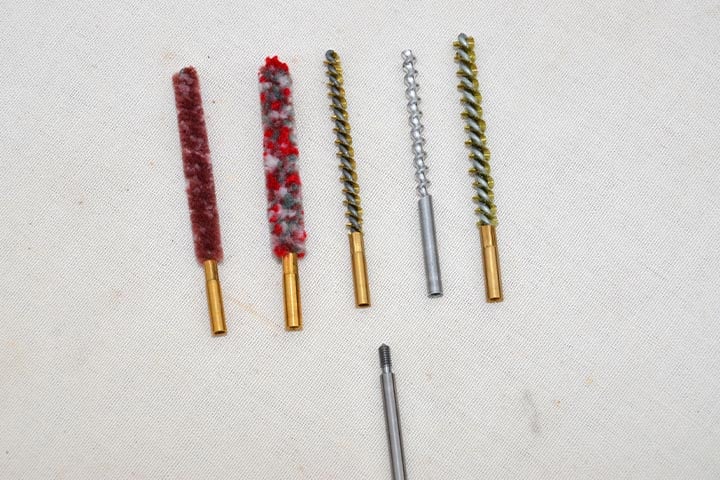
First, let’s discuss the process involved. Unlike a firearm which has to deal with incredible pressure, an airgun barrel gets a far easier life, so for this reason, is manufactured from mild steel. Attacking it with stiff jagged cleaning rods and phosphor bronze brushes, really isn’t a clever idea, and these are best avoided.
Airgun Dedicated Cleaner
In addition, unlike an open, easily accessible shotgun barrel, cleaning an airgun, especially a PCP requires more care and subtlety, in order not to damage the guns’ mechanism. To that end, specialist cleaning oils and compounds should be used, which are designed specifically for airguns; ensuring that sensitive ‘o’ rings and seals wont be damaged in the process.
Pull-Through Is Sufficient
In reality, to get the job done for routine cleaning, a pull-through system used with care, is the way to go, and quite sufficient for normal use. So for the job, we need a pull through line with a small handle, small patches, and barrel cleaning solution/ lubricant. For those that wish to improvise, strong coated fishing trace wire can be used, doubled up to create a loop. Add your handle, and it can work nicely. As for the cleaning solution, the fairly old fashioned Youngs 303 does the job, but it does have a pungent odour which lingers for days, so you may lose a few friends over it! Other notable brands include CLP which stands for Cleaner, Lubricant, Preservative. Fairly odourless and highly effective. Dedicated patches that wont jam in the barrel are worth buying, and cost peanuts.
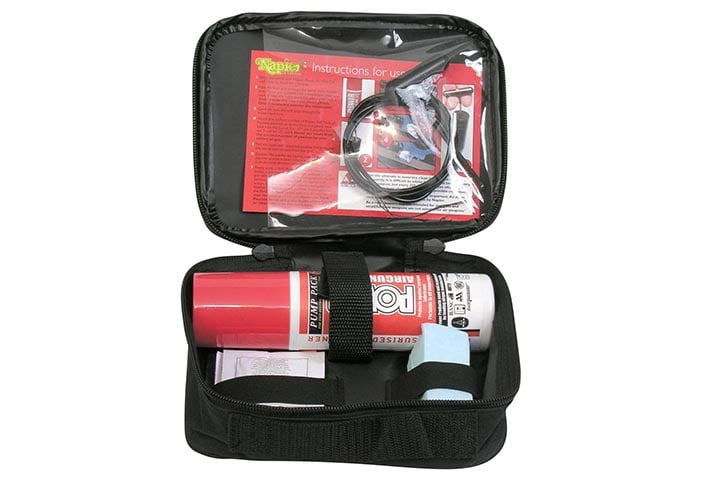
However, Napier of London are also a respected name in gun care products, and have industry endorsements; and they make things really easy since they produce their own Universal Pull Through Cleaning Set. The set includes everything we need too:- pull-through line, Napier Airgun Power Oil, cleaning patches and instructions, all for reasonable money.
The Process
So here’s the process to clean a conventional PCP airgun:
First we need direct access to the lip of the barrel ideally, so remove a silencer if necessary. If it doesn’t unscrew, it could be held in place with small grub screws. Apply the safety if there is one, pull back the rifle’s bolt (or side-lever) to cock the gun and leave the bolt open.
Now feed the pull-through cable into the muzzle and push it all the way until it emerges at the breech.
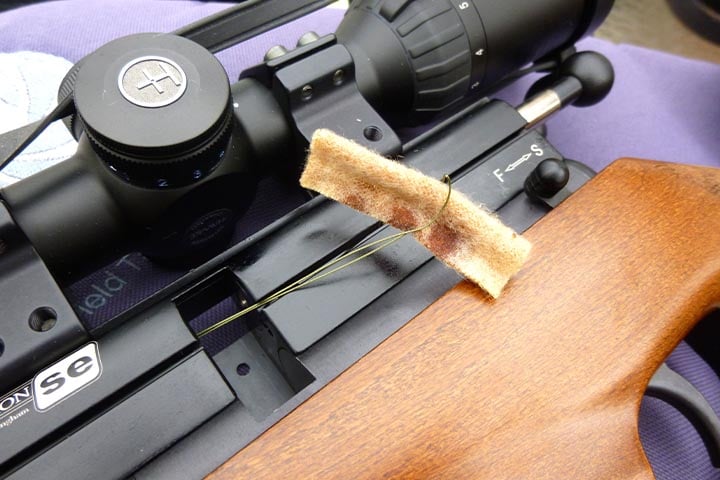
Feed a small cleaning patch into the loop on the line, and apply a few drops of cleaning solution/ oil to slightly dampen the patch.
Now hold the gun upside down to avoid any excessive cleaner entering the transfer port, and pull the line back through the barrel. As it emerges from the barrel, you should see how dirty the patch is.
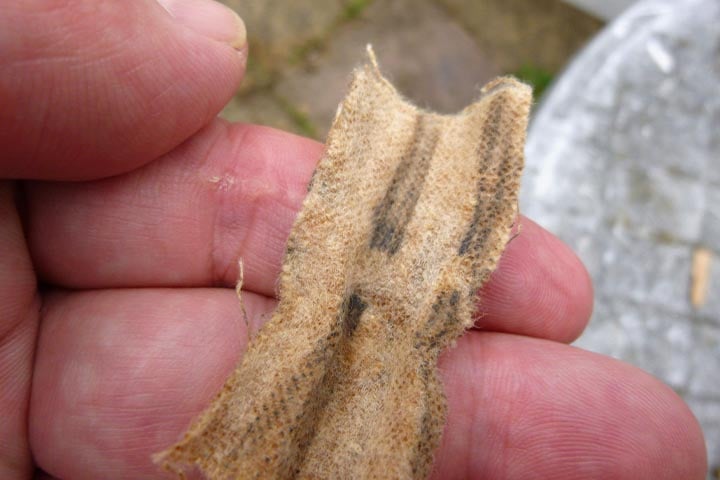
Repeat the process 3-4 times and when relatively clean, it should be job done. Fire off the gun each time while the gun is upside down and any excess oil should be expelled, preventing it from accessing the transfer port.
Awkward Muzzle Brakes Etc.
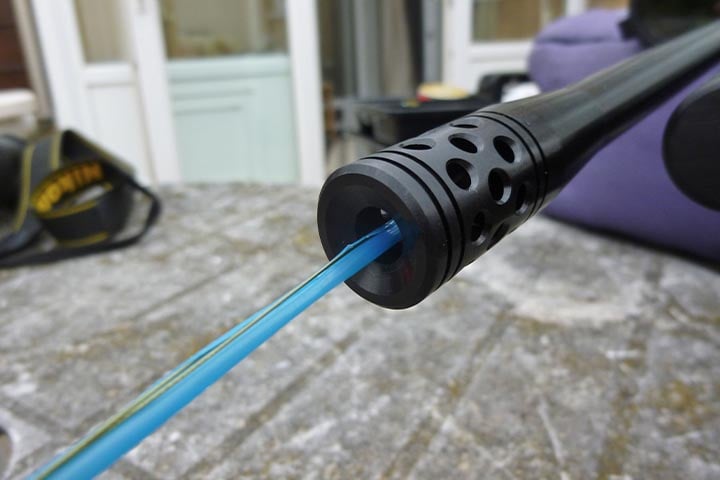
Some guns will have a muzzle brake attached to the gun, and if this is bonded on, or secured inside a ‘figure-of-8’ barrel clamp, then it is far preferable to clean the barrel with the unit left in situ.
In this scenario, accessing the lip of the barrel can be tricky, so the trick is to utilize a conventional drinking straw, feed the straw into the barrel, then feed the pull-through line into the straw and in turn, into the barrel. Slide the straw away (use a split straw if necessary), and clean as normal as per above process.
Alternative Methods
Some shooters favour felt cleaning pellets, but if these are to be used in a spring powered gun, you will need to insert an actual lead pellet behind the cleaning pellet, to avoid damage to the piston as the gun fires.
Final Check/ Barrel Idiosyncrasies
With our barrel now cleaned, it just remains to re-check performance and see if those groups have tightened up. But be aware of possible variation between barrels, and the way they can react to cleaning. Zero may need to be fractionally reset, but some barrels can shift zero by a few inches after cleaning, both vertically and horizontally, then after 10 or twenty shots, the impact point tracks back to where it was prior to cleaning. With another barrel, the impact point may not change at all.
Just be aware and learn the behaviour of your particular gun; take care and keep on top of performance, and you may just be surprised at the results!
Happy Shooting
Range & Country