Slide-on Fit
Dedicated silencers for a particular make and model, are often of the slide-on variety, and here a close fit is important for true alignment. With modern CNC manufacturing tolerances, this shouldn’t be a problem, and this type of silencer will fix in place using one or two small grub screws, to be tightened with an allen key.
Consideration with a PCP
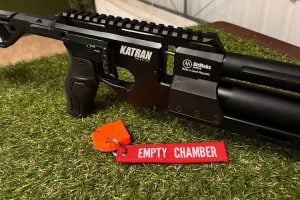
When fitting this style of silencer onto a PCP, where a figure of 8 barrel clamp is present, it pays to leave a small gap between the silencer and the clamp, rather than sliding it right alongside. This is to allow for any tiny movement as the gun’s main cylinder expands. This is a natural phenomenon that occurs to a greater or lesser degree with PCP’s as cylinder pressure drops through the charge. Lock up everything tight together and the barrel may be forced to fractionally flex, which could affect the point of impact.
Calibre Specific
Several manufacturers now make silencers specified as ‘Calibre Specific’, and this means that the exit hole in the silencer is only just greater than the particular calibre specified.. The idea being that very little air escapes around the pellet, making the shot quieter still. Likewise any baffles incorporated will be similarly sized down, so this type of silencer relies on being a perfect fit, so as not to compromise accuracy.

Clipping?
Any alignment issues, from a badly fitting / mismatched silencer, may result in pellets actually ‘clipping’ the inside lip of the silencer, as they exit the muzzle. Tell-tale grey splashes maybe visible at the muzzle which will indicate this is happening.
Reflex
Adding a silencer can make sense in many situations, but some ultra compact guns can lose some appeal if too much extra length is added. That’s where what’s termed a ‘reflex’ silencer can come in handy. These are designed to slip right over over the barrel, with the internal threaded section actually starting a few inches inside the body of the silencer. This results in around half the length or more of the silencer sitting over the barrel. Thus a 6inch silencer may actually only add 3inches to the guns length. There’s obviously less room inside for expansion chambers, and the reflex design relies on a gun having enough clearance around its barrel, but where suitable, they can be a neat solution.

Modular Designs
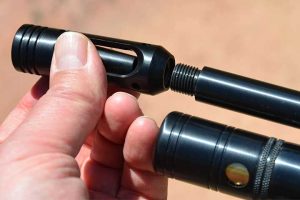
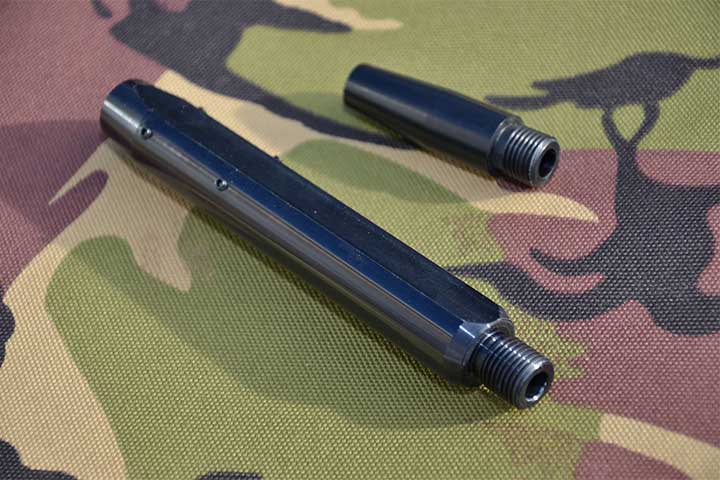
Some silencers offer a modular design, whereby the body is made up of several sections. A short chamber, medium, and longest section, for example, which can all be dismantled and reassembled, in a number of different configurations. This can alter the length of the unit, the silencing capabilities, and also overall weight, which can all be fun experimentation, as well as a fine tuning exercise.

Easy Strip?
It’s probably fair to say that the quietest silencers or moderators incorporate wadding into the design as well as baffles, and the wadding can take the form of soft material. Several silencers from popular brands incorporate plastic perforated tubes which look very similar to hair curlers, and these are then used to contain soft wadding around the walls of the silencer tube. All very well for eating decibels and deadening the muzzle report, and these silencers are undeniably highly effective and popular. But that same material can also become damp if exposed to excessive moisture and fray and degrade over time.

So it pays to look after our kit for maximized results. Some silencers make the job easy, allowing for one end to be unscrewed, and the contents slid out for a periodic inspection.
The Sound of Silence
Silence could well be golden then, and the satisfaction that comes from shooting a super quiet , properly moderated airgun is not to be underestimated. For the benefits are many and varied. It’s the way to go for sure for anyone wishing to go hunting, as a quiet rifle wont spook the quarry. But just as important is to minimize irritation to any nearby neighbours. A constant crack of a rifle report on a blazing summers afternoon can be a major source of irritation, and whilst we have every right to enjoy our sport, why be a source of annoyance when it can be avoided?
Finally, unlike firearm specified silencers, the units we buy for airguns are fairly modestly priced. A silencer can in some cases improve accuracy, simply by effectively adding weight to the barrel; a point we’ll expand upon in a forthcoming blog on barrel harmonics, muzzle brakes and air-strippers.
So it’s an accessory which can transform the feel and handling of our treasured rifles, for little outlay, which has to be an exciting proposition, and well worth experimentation.
Still not sure which one fits your barrel? Give the shop a call, we’ll help you find the right match.
Happy shooting!
Range & Country