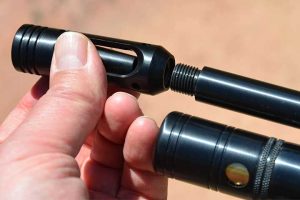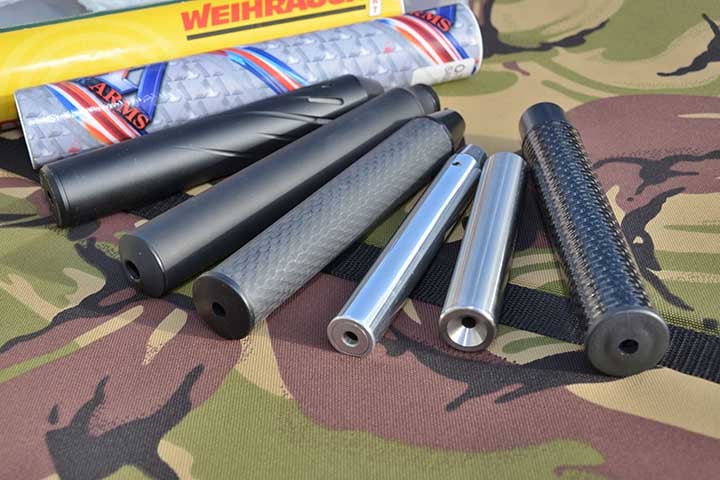
Airgun silencers or moderators, are an intriguing subject all on their own, and as a relatively inexpensive add-on accessory, they can make a big difference where performance and feel are concerned. Many countries actually place restrictions on the use of airgun silencers, for reasons which often defy logic, yet here in the UK, we are fairly free to experiment, as no restrictions exist appertaining to silencers for airguns below the 12ft/lbs UK power limit. Time, we think, to take a closer look.
Basic Principle
The basic idea of a conventional silencer, is to offer an expansion chamber for air and gases as they exit the barrel, behind the projectile. In its simplest form, the silencer is an empty tube, with just a small hole at the muzzle, but many more complicated designs are available. Some silencers feature what is termed ‘baffles’ set within the silencer tube, and these take the form of discs similar to a large washer. The air hits the rim and is then forced through the central aperture. With baffles spaced apart, set effectively in series, the turbulent air is tamed and dissipated after passing through the silencer. This whole process should at least moderate the muzzle blast, and active baffles, where the discs actually move back from the air blast, against a small spring, can help reduce noise even further.
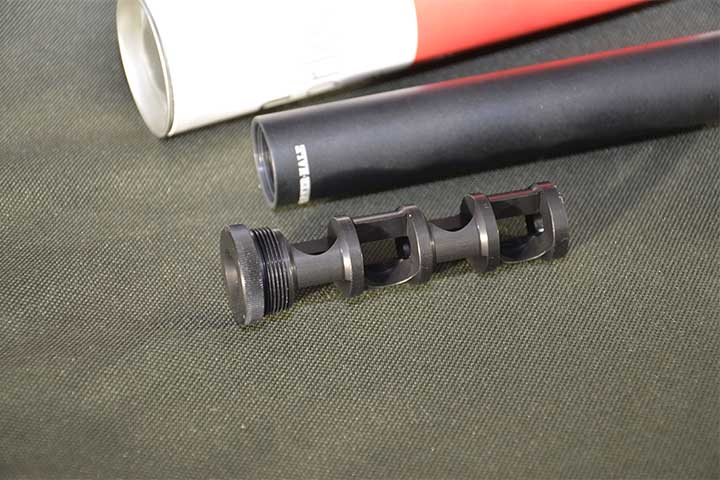
Some silencers incorporate what’s known as back-venting, where the silencer has ports or small holes cut into the rear of the tube. Expanding air is designed to escape with this design, to a greater or lesser degree, and results can be impressive. It’s all about absorbing decibels at the end of the day, and in some cases, minimising muzzle flip (the phenomenon of the barrel kicking upwards as the shot is released) along the way.
Just How Effectiveness Are They?
What sort of gun we fit a silencer to, is significant though, as it affects the outcome. Add a silencer or moderator to a spring powered gun, and the effect is never that impressive, for the simple reason that the action of a springer makes such a noise, that this will always stand out. The way the air is compressed and delivered on a springer is far more gradual and progressive. Against this, a pre-charged pneumatic is a completely different animal. Here, as the trigger is pulled, a pulse of rapidly expanding pre-compressed air is released, and this makes a significant loud crack as the air exits the muzzle. Fit a silencer to a PCP in this scenario, and you’ll see a huge difference as the muzzle crack is literally reduced to a whisper.
Pros and Cons
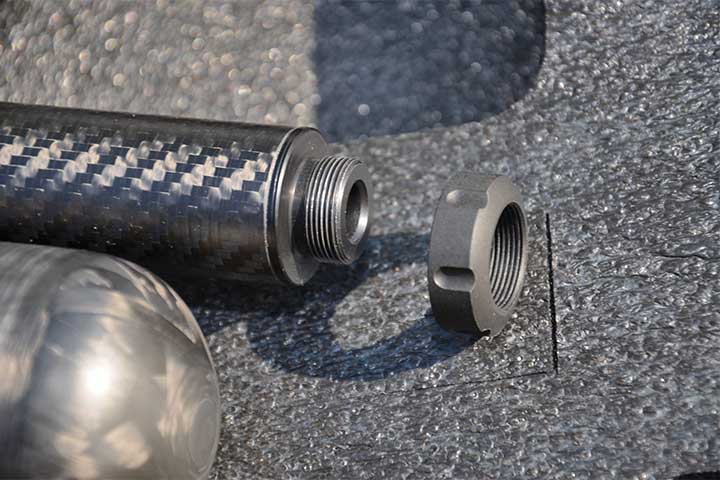
Adding a silencer can alter the feel of an airgun, so some consideration is needed. There are plenty of pros and cons, and it really is governed by personal taste. Opt for a carbon fibre bodied example however, and the sheer lack of weight means the guns equilibrium shouldn’t be upset. However, fix in place a sizeable steel model, and it can really play around with balance. To be fair, most airgun silencers tend to be made from aluminium, as unlike firearms, they have a a significantly reduced muzzle blast to deal with.
But aside from taming muzzle crack, silencers can bring other benefits, purely by virtue of that extra mass up front. More muzzle weight means balance is shifted forwards, but you may well find this helps stabilize the gun on target, particularly from the standing position. Others will find this spoils the balance and bemoan the loss of the guns compact credentials, so it really is a case of personal preference.
Adding a silencer may well alter the gun’s zero, sometimes by a few inches, and it makes sense as the harmonics of the barrel have been fractionally altered. Effectively, and in theory, adding a silencer dampens down the barrels movement/ vibrations during the shot cycle, and this can have a beneficial calming effect, with the result that accuracy is easier to come by. Keeping an eye on the fixings, and periodically checking all screws are nipped up, particularly on a recoiling springer, will at least discount any basic errors, where the unit works itself loose.
Best Fittings
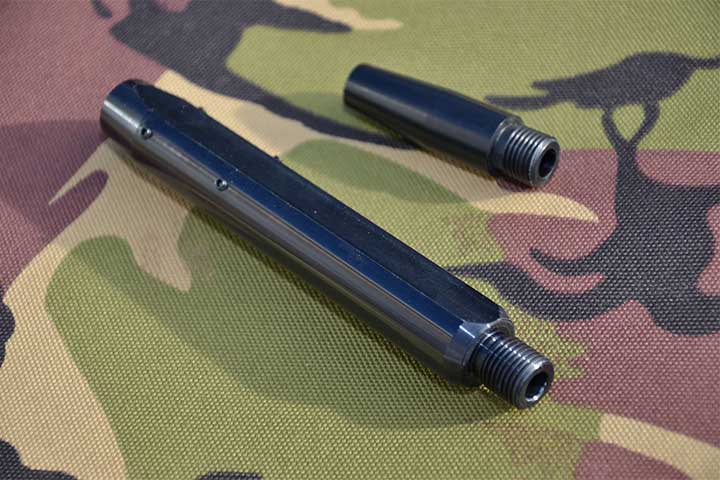
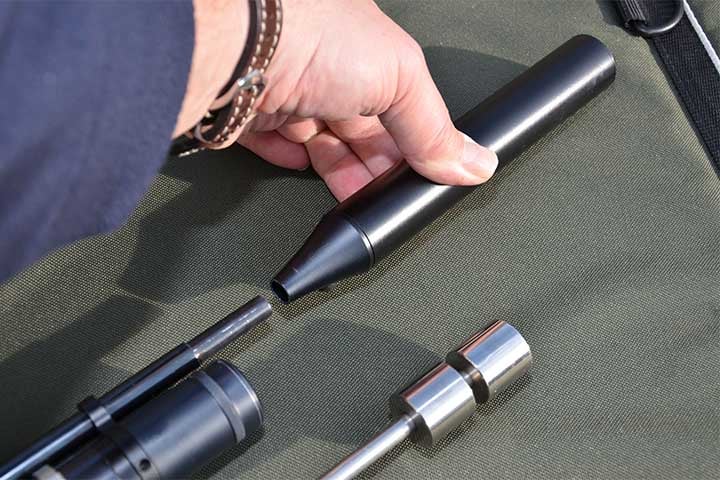
Whilst some manufacturers design a gun to accept only their own silencer specification, many brands now supply models with a fairly standard 1/2inch UNF thread on the muzzle; making it really easy to source an appropriate silencer. Indeed any silencer with the female thread, can be simply screwed into position. However, in the absence of this, it’s a simple task, and fairly inexpensive, to purchase a barrel adaptor which will slide over the gun’s barrel and tighten up with a screw. Thereafter, the 1/2inch UNF thread at the front of the adapter, can be utilized.
In part 2 of this blog, we’ll focus on the variety of silencers available, and look in more detail at how to get the best from our favourite accessory.
Until then, good shooting!
Range & Country