The great thing about airgun shooting is that we can enjoy it at any level. If you want to keep things simple and participate in pure fun shooting, who can tell you any different, but for others, pushing performance to the very limit is the name of the game.
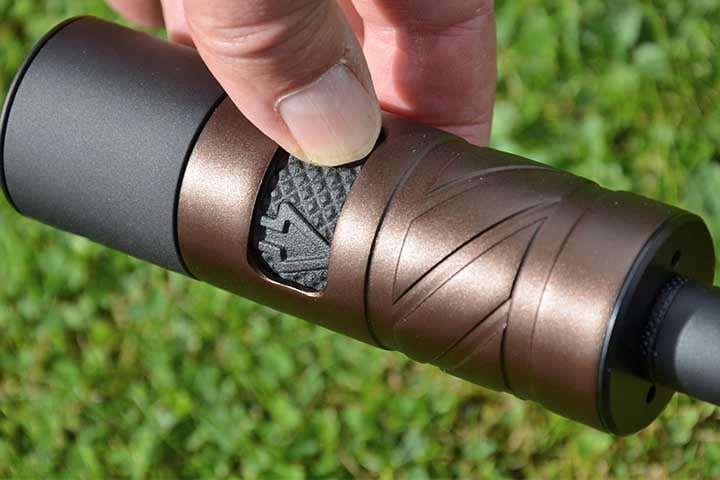
Fall into the latter camp, and there’s a whole raft of tweaks and modifications just waiting to be explored. It’s stating the obvious, but the barrel is a vital component to any airgun, if we’re looking for top performance, and there’s no doubt that premium brands tend to have the edge in this area.
In this blog we look at devices to add to the barrel to alter shot characteristics and affect performance. They can make a real difference, or they can have little affect. But the journey, for many, is half the fun.
Muzzle Brakes
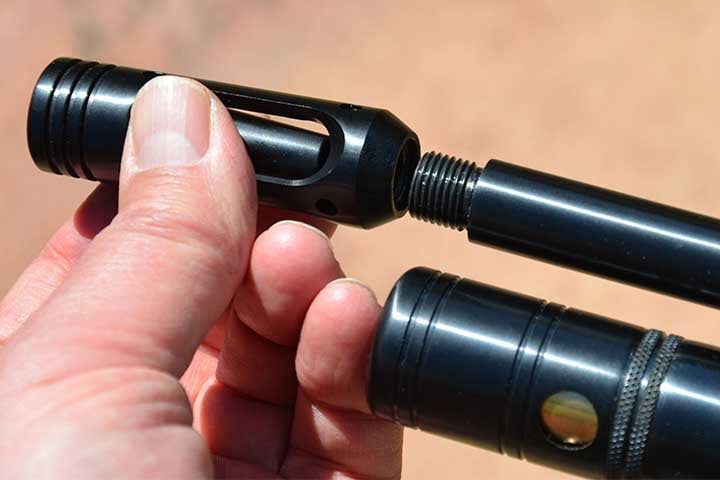
Various devices exist which can be fixed onto the barrel to affect the shot characteristics, and a Muzzle Brake is one such fitting which is worth consideration. Muzzle Brakes come in all manner of configurations, and are most effective when fitted to a PCP.
They are designed to vent the spent air, and some custom designs popular with Field Target shooters, feature a series of slots cut into the top, which then direct airflow upwards. This is intended to counteract the phenomenon known as ‘muzzle flip’ where the barrel flips upwards as the shot releases.
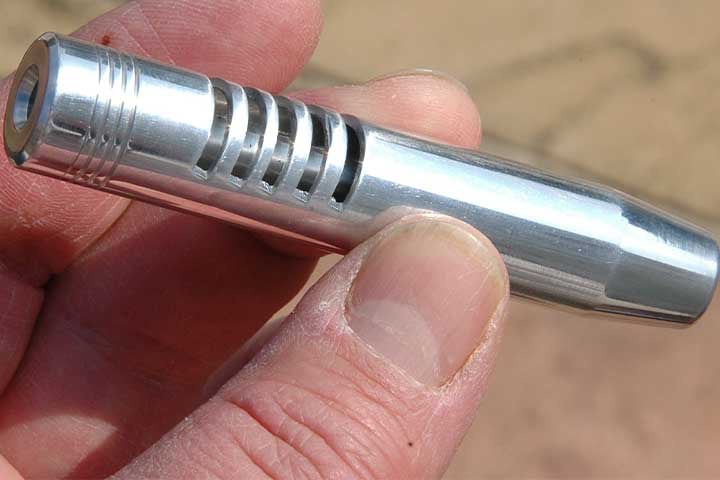
Muzzle Brakes work to a greater or lesser degree, though the gun can still be noisy as they are obviously not a silencer. Some are threaded for a ½ inch UNF fitting, (the more standard spec) and others can be made as a slide-on for a particular barrel diameter/ model, held in place with grub screws. Again like silencers, they can be fitted using a barrel adaptor, from companies such as Best Fittings.
Air Strippers
Air Strippers are an increasingly popular device which can connect in the same way to the end of the barrel. These again have ports or holes cut into the outer body, but also feature a small aperture, either a hole, series of holes, or an internal cone section. The idea here is that the pellet exits the barrel, then almost immediately passes through the aperture or cone, and this has the affect of stripping away the spent turbulent air following the pellet, leaving it unruffled on it’s way to the target.
In some cases, the cone is designed to be adjustable, so that the distance between the lip of the barrel and the entry point of the cone, can be fractionally increased or decreased. Get the distance just so, and groups can be seen to visibly tighten in some scenarios.
BSA toyed with this idea including a factory fitted air stripper with their now discontinued Goldstar PCP, although they do still produce a small pepper pot style barrel diffuser. Air Arms fit their super successful HFT500 with a factory fitted air stripper, along with the range-topping, World Championship winning XTI-50, and who can argue with the hatful of tournament wins held by these two models
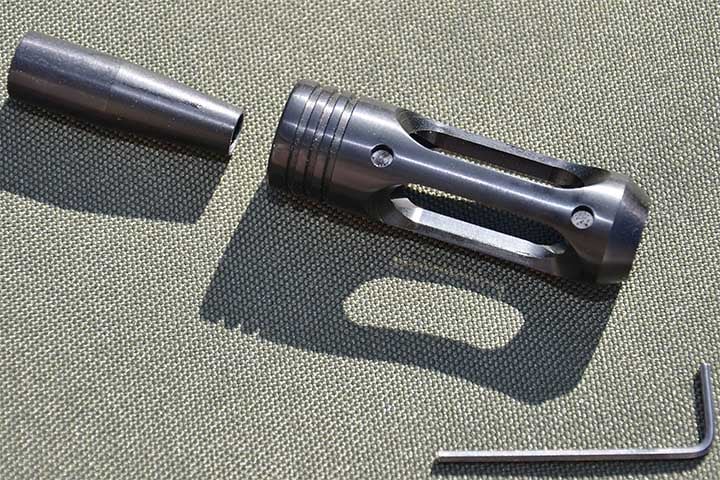
After-market air strippers are also available from a variety of sources, with Rowen Engineering a popular name.
Barrel harmonics
Of course, alter the positioning of that air stripper cone, and yes we are interrupting the air flow, but we are also fractionally altering the barrel harmonics- and barrel harmonics is another fascinating area of experimentation.
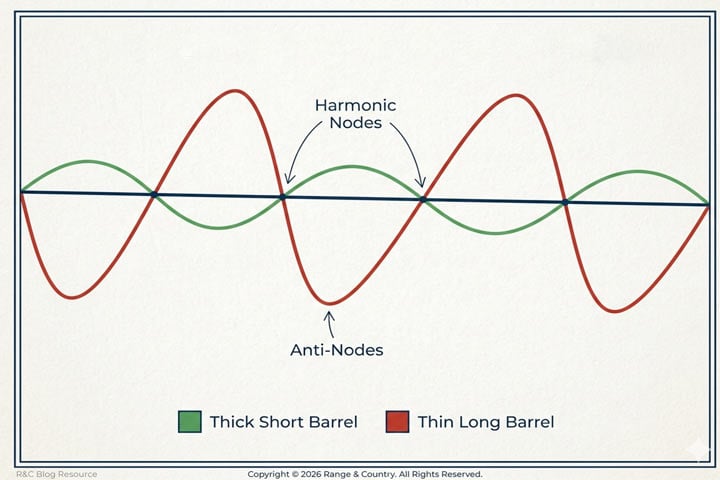
A Barrel Harmonizer is an idea from the firearms world, but it was the late great JohnWhiscombe that introduced them to the airgun industry, with his intriguingly recoilless spring powered Whiscombe JW50 and JW60 models. The principle sees a movable weight that sits around the muzzle, and by fractionally moving the weight, forward or back, we are altering the barrel’s harmonics. Watch a gun barrel in slow motion, and it actually vibrates in a rippling motion. Physics dictates that a thick short barrel vibrates more mildly than a long thin barrel, and the idea is to control and alter those vibrations, so that the pellet exits the barrel at a ‘harmonic node’ – a point of least movement- improving overall accuracy.
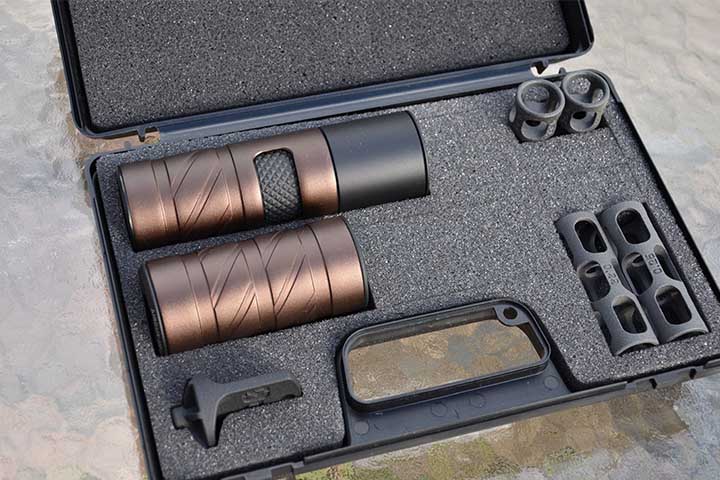
0DB produce their Advantage Target Pro barrel tuner and SSP Silencer kit, via Daystate, and this offers customers a full box of tricks to play with. Whether it has the desired affect isn’t guaranteed, but it does offer the enthusiast hours of fun on the range, along with pleasing aesthetics.
Caveat
In conclusion, if a particular gun is blisteringly accurate from the start, then we could just opt to leave well alone and enjoy using it. However, if you feel there’s a bit more performance to extract, then it could be time to play. And remember, the beauty of barrel fittings are that they can be added for experimentation, or instantly removed and the gun returned to its original state. And with trial and error and experimentation a big part of our sport’s enjoyment for many, it would be rude not to, as they say.
As always, happy shooting.
Range & Country